Rajkot
08042754690
+918411958100

NTS

about-cover-bg image
About Narmada Technical Services

The Best Manufacturer in rajkot

Services
Featured Services

What We Do

6814772a5d263414004dd4a4 Card 2

product image
Radiography Testing

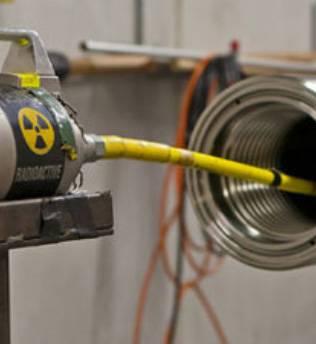
Radiographic Testing (RT) is a Non Destructive examination (NDE) technique that involves the use of either x-rays or gamma rays to detect internal flaws in the test item. During Radiographic Testing, the test-part is placed between the radiation source and film (or detector). The radiation will pass through the test items and depending upon density and thickness of the material, amount of radiation passed through the test item and will expose the x ray film to form radiographic image on the film. Film is then processed and a permanent image is formed on the film. This processed film is known as a radiograph which gives details of flaws in the test item. The radiograph is then evaluated according to the given acceptance standard and final radiography test report is prepared by a qualified NDT personal. Depending upon the size, shape, complexity, thickness variation in different sections of the test item, number of segments and film size to be used is decided and accordingly a test item is covered for the desired results. We Have radiation sources such as Ir-192, Co-60 and X -ray (up to 350 KV). These sources have different penetrating capacity for material to be tested radiographically as per the following: Ir-192 radiography source: maximum 70 mm thickness of steel or steel equivalent. Co-60 radiography source: 40 mm to 200 mm thickness of steel or steel equivalent. X-ray radiography source: 50 mm of steel thickness or steel equivalent. Various test items are tested with different radiography techniques as per the given testing specification e.g. ASME Section V, EN specifications etc. as per the requirement of the customers. Castings: Steel Casting of section thicknesses up to 200 mm, other material having section thicknesses of 200 mm steel equivalent can be tested with above mentioned radiography sources. All such castings are required in various industrial sectors such as: Defense, Power sectors, automobile, Oil and Gas etc. Welding: High temperature and high pressure welding application equipment such as - Pressure Vessel, Tanks, processing equipment for chemical, Oil, Petroleum industries etc. Radiography Testing is widely used for flaw detection and as a quality assurance tool in industries for in stage inspection as well as at the finished stage of the product. It is also used during the maintenance of equipment such as - Boilers, Pressure vessels, RLA - Remnant Life Assessments. some major industries where Radiography Testing is extensively used for quality assurance- Aerospace Industry Defense Offshore Industry Marine Industry Power Generation Industry Petrochemical Industry Automobile Industry Fabrication Industry where high temperature high pressure welding is to be tested Infrastructure, Mining

6814772a5d263414004dd4a4 Card 2

product image
Ultrasonic Testing

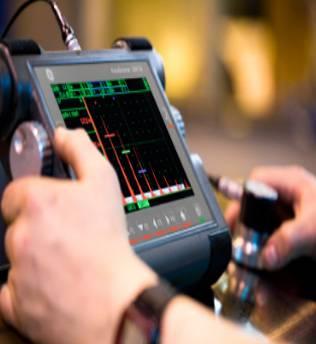
Ultrasonic testing (UT) is a non-destructive test method that utilizes sound waves to detect discontinuities in the test items. Sound waves are transmitted in the test items. Depending upon the orientation of the discontinuity in the test item it can be seen as an indication on the display screen on the Ultrasonic Flaw Detector. Ultrasonic waves are sound waves of higher frequency i.e. 20000 Hz and above. The ultrasonic contact pulse reflection technique is used. This system uses a transducer that changes electrical energy into mechanical energy. The transducer is excited by a high-frequency voltage, which causes a crystal to vibrate mechanically. The crystal probe becomes the source of ultrasonic mechanical vibration. The transmission of ultrasonic waves can be at perpendicular direction or at an angle as per the requirement. These vibrations are transmitted into the test item through a coupling fluid, usually a film of oil, called a couplant. When the pulse of ultrasonic waves strikes a discontinuity in the test piece, it is reflected back to its point of origin. Thus the energy returns to the transducer. The transducer now serves as a receiver for the reflected energy. The indications of echoes are seen on the display of Ultrasonic Flaw detector which are analyzed to arrive to a conclusion. Based on the analysis a test report is prepared and submitted to the customer. The detection, location, and evaluation of discontinuities become possible because the velocity of sound through a given material is nearly constant, making distance measurement possible, and the relative amplitude of a reflected pulse is more or less proportional to the size of the reflector. One of the most useful characteristics of ultrasonic testing is its ability to determine the exact position of a discontinuity in a weld. The testing requires a skilled and competent testing personal. Testing procedure has to be prepared for a pre determined objective of the testing. This testing method can be used on ferrous and nonferrous materials, is often suited for testing thicker sections accessible from one side only, and can often detect finer lines or plainer defects depending on the orientation of such defects in the test item which may not be as readily detected by radiographic testing. The main advantage of this test method over radiography testing is that flaw detection is possible when only one side on the testing surface is available. When it is not possible to test with radiographic technique, ultrasonic testing may be an alternative test method. Also the results are instant as processing time is not required unlike in radiography testing. The testing can be performed up to 5 meters of steel thickness depending upon its grains size and acoustic properties. Other materials can also be tested depending upon material response to ultrasonic waves. We Provide Ultrasonic Testing For Various Industrial Products to Detect Internal Flaws. Following are some examples: 1. Raw Products such as - Plates, Round Bars, Square Bars, Billets, Castings etc. 2. Welding - Pipe welding, Pressure parts weld joints - Boiler Drum, Heat exchangers, Pressure Vessels, Plate welding, Nozzle joints, other weld joints of various weld geometry. 3. Forgings and forged component. 4. Ultrasonic Thickness Gauging

6814772a5d263414004dd4a4 Card 2

product image
Magnetic Particle Testing

Magnetic Particle Testing Magnetic particle testing or MPT is a nondestructive testing method for locating surface and near surface discontinuities in ferromagnetic materials. It depends for its operation on the fact that when the material or part under test is magnetised, discontinuities that lie in a cause leakage field to the direction of the magnetic field will cause a leakage field to be formed at and above the surface of the part. The presence of this leakage field, and therefore the presence of the discontinuity, is detected by the use of finely divided ferromagnetic particle applied over the surface, some of the particle being gathered and held by the leakage field. This magnetically held collection of particle forms an outline of the discontinuity and generally indicates its location, size, shape and extent. Magnetic particles are applied over a surface as dry particles, or as wet particle in a liquid. Ferromagnetic materials include most of the iron, nickel and cobalt alloys. These materials lose their ferromagnetic properties above a characteristic temperature called the Curie point which is approximately 760? C for most of the ferromagnetic material. Applications: The principal industrial uses of magnetic article testing are final inspection, receiving inspection, in process inspection and quality control, maintenance and overhaul in the transportation industries, plant and machinery maintenance and inspection of large components. In Magnetic Particle Testing We Have Electra Magnetic Yokes To Detect Surface And Sub Surface Flaws In Ferromagnetic Material For Industrial Sector Of Casting, Welding, Forgings And In Service Products.

Have any custom requirements?