Rajkot
08042754690
+918411958100

ultrasonic testing

6814772a5d263414004dd4a4 Card 2

product image
Ultrasonic Testing

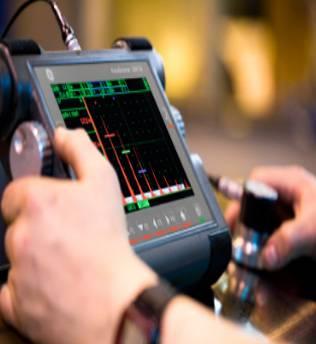
Ultrasonic testing (UT) is a non-destructive test method that utilizes sound waves to detect discontinuities in the test items. Sound waves are transmitted in the test items. Depending upon the orientation of the discontinuity in the test item it can be seen as an indication on the display screen on the Ultrasonic Flaw Detector. Ultrasonic waves are sound waves of higher frequency i.e. 20000 Hz and above. The ultrasonic contact pulse reflection technique is used. This system uses a transducer that changes electrical energy into mechanical energy. The transducer is excited by a high-frequency voltage, which causes a crystal to vibrate mechanically. The crystal probe becomes the source of ultrasonic mechanical vibration. The transmission of ultrasonic waves can be at perpendicular direction or at an angle as per the requirement. These vibrations are transmitted into the test item through a coupling fluid, usually a film of oil, called a couplant. When the pulse of ultrasonic waves strikes a discontinuity in the test piece, it is reflected back to its point of origin. Thus the energy returns to the transducer. The transducer now serves as a receiver for the reflected energy. The indications of echoes are seen on the display of Ultrasonic Flaw detector which are analyzed to arrive to a conclusion. Based on the analysis a test report is prepared and submitted to the customer. The detection, location, and evaluation of discontinuities become possible because the velocity of sound through a given material is nearly constant, making distance measurement possible, and the relative amplitude of a reflected pulse is more or less proportional to the size of the reflector. One of the most useful characteristics of ultrasonic testing is its ability to determine the exact position of a discontinuity in a weld. The testing requires a skilled and competent testing personal. Testing procedure has to be prepared for a pre determined objective of the testing. This testing method can be used on ferrous and nonferrous materials, is often suited for testing thicker sections accessible from one side only, and can often detect finer lines or plainer defects depending on the orientation of such defects in the test item which may not be as readily detected by radiographic testing. The main advantage of this test method over radiography testing is that flaw detection is possible when only one side on the testing surface is available. When it is not possible to test with radiographic technique, ultrasonic testing may be an alternative test method. Also the results are instant as processing time is not required unlike in radiography testing. The testing can be performed up to 5 meters of steel thickness depending upon its grains size and acoustic properties. Other materials can also be tested depending upon material response to ultrasonic waves. We Provide Ultrasonic Testing For Various Industrial Products to Detect Internal Flaws. Following are some examples: 1. Raw Products such as - Plates, Round Bars, Square Bars, Billets, Castings etc. 2. Welding - Pipe welding, Pressure parts weld joints - Boiler Drum, Heat exchangers, Pressure Vessels, Plate welding, Nozzle joints, other weld joints of various weld geometry. 3. Forgings and forged component. 4. Ultrasonic Thickness Gauging

Phone Number

Email Address info@ndtgodavari.com

Mon-Thu: 10 AM - 2 PM • Fri: 3 PM - 7AM

Other Website Visit our other website
Address PLOT NO 14/7, SURVEY NO 236, Nr.Bhumi Polymer,VIKAS STOVE ROAD, VERAVAL, Shapar,

Rajkot, India, 390024